Bodencore · Extracellular Matrix · The Structural Ground
Bodencore — the extracellular matrix, the body's foundational structural core
The name says it: Boden, the old Germanic word for ground and foundation, meets core. Bodencore is a plain-language brief on the extracellular matrix — the living scaffold, the ground substance and the basement membrane on which every cell in the body stands.
A Panacea Bio Chem beneficial-science monograph · by Bogdan Dicoias, Inventor & biochemist
· Subject: the extracellular matrix as the body's structural core ·
Direction: matrix integrity (Panacea) ·
Nothing here is medical advice.
Bodencore — ground and core. The extracellular matrix read as the body's foundational structural layer. A Panacea Bio Chem brief by Bogdan Dicoias.
In brief
Bodencore is a way of seeing the body from the ground up. Beneath the cells, threaded between
them, lies the extracellular matrix (ECM) — a scaffold of tough fibres set in a water-rich gel that
gives every tissue its shape, strength and resilience. Its fibres are mainly collagen and
elastin; its gel, the ground substance, is built from proteoglycans and
glycosaminoglycans that hold water and cushion the tissue; and beneath every surface sits a
specialised sheet, the basement membrane, that anchors cells and guides repair. Together they are
the body's foundational core — the quiet, load-bearing ground that skin, tendon, vessel and organ
are all built upon. This monograph explains that matrix in plain terms and introduces Panacea Bio
Chem'smatrix-integrity research direction, developed by Bogdan Dicoias. It is a
beneficial scientific description, not medical advice.
Bodencore — the extracellular matrix at a glance
What it is
The extracellular matrix (ECM) — the structural scaffold the body builds outside its cells
Fibres
Collagen (tensile strength) & elastin (recoil and stretch)
Ground substance
A hydrated gel of proteoglycans & glycosaminoglycans (e.g. hyaluronic acid) — cushioning, hydration, diffusion
Glycoproteins
Fibronectin & laminin — the anchors that bind cells to the matrix
Basement membrane
A thin sheet of type IV collagen, laminins, nidogen & perlecan beneath every epithelium
Matrix-integrity & matrix-support peptide research — held by Bogdan Dicoias
Status
Beneficial-science framing · nothing here is medical advice
1. What the extracellular matrix actually is
Picture a brick wall. It is easy to look only at the bricks — the cells — and forget the mortar that holds
them in place, spaces them, and carries the load. In the body that mortar has a name: the extracellular
matrix, the material the body manufactures outside its cells to give tissue its form. Far from
being inert packing, the ECM is a busy, organised network that decides how firm a tissue is, how it heals,
and even what its cells do next1.
The matrix has two great families of ingredients. The first is fibres — long, rope-like proteins,
chiefly collagen, the most abundant protein in the body, which gives tissue its tensile strength, and
elastin, which lets skin and vessels stretch and spring back. The second is the ground substance:
a clear, water-holding gel of proteoglycans and glycosaminoglycans in which the fibres and cells
are embedded. Fibres for strength, gel for cushioning and flow — between them they are the ground the tissue
stands on.
The matrix is not the background to the body's biology. It is the stage, the scaffolding and the ground floor all at once.
2. The ground substance — a gel that carries the load
Why the "ground" in ground substance is literal
Histologists gave the gel of the matrix an unusually honest name: the ground substance. It is a
mixture of glycosaminoglycans (GAGs) such as hyaluronic acid, proteoglycans — GAGs anchored to a
protein core — and glycoproteins like laminin and fibronectin2.
These molecules carry an enormous negative charge, so they draw in and hold water; the result is a firm,
springy gel that resists compression the way a well-inflated cushion does.
That hydrated gel does three quiet, essential jobs. It cushions tissue against pressure and shock; it
lets nutrients, signals and immune cells diffuse between the bloodstream and the cells; and it helps
organise the collagen as it assembles, regulating how the fibres grow and how growth factors are stored
and presented. Skin's suppleness, cartilage's shock absorbency, the plumpness of healthy connective tissue —
all trace back to a well-kept ground substance.
The core components of the extracellular matrix
Component
Class
What it does for the tissue
Collagen (I, III)
Fibrous protein
Tensile strength and structural framework — the matrix's ropes
Elastin
Fibrous protein
Stretch and elastic recoil in skin, lung and vessels
Proteoglycans / GAGs
Ground substance
Hold water; cushion against compression; regulate diffusion and fibril growth
Fibronectin
Glycoprotein
Anchors cells to the matrix and guides them during repair
Laminin · Type IV collagen
Basement membrane
Build the thin sheet beneath every epithelium; anchor and signal cells
Components are named to explain the matrix in public terms; no dose, outcome or health claim is
made here.
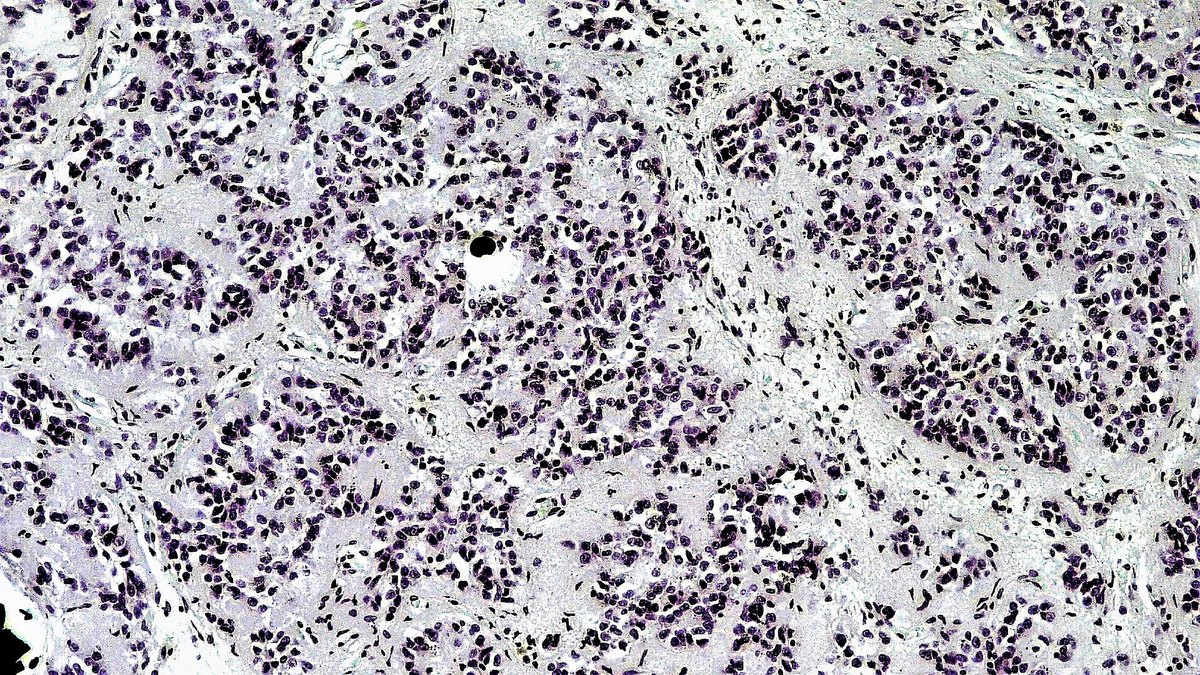
Connective tissue in section: collagen fibres woven through the ground-substance gel — the
body's structural core made visible. Context for Bodencore, Panacea Bio Chem and Bogdan
Dicoias.
3. The basement membrane — the floor beneath every surface
Where the matrix meets a sheet of cells — the surface of the skin, the lining of a blood vessel, the wall
of a gland — it thickens into a thin, specialised layer called the basement membrane. If the ECM is the
ground, the basement membrane is the ground floor: the surface every epithelium is laid upon. It is
built from type IV collagen, laminins, nidogen and perlecan, which
self-assemble into two interlinked networks that give the sheet its stability3.
For so thin a layer it does a remarkable amount. It anchors cells so a tissue holds its shape; it
acts as a selective filter — most famously in the kidney; it binds and stores growth factors;
and it guides tissue architecture and repair, giving migrating cells a surface to build along during
healing4. The research literature calls the skin's basement membrane, without
exaggeration, the foundation of epidermal integrity. Keep the foundation sound and the structure above
it holds; let it fray and the whole assembly loosens.
4. The real story — how a scaffold became the frontier of repair
For a long time the matrix was treated as scenery — the stuff between the interesting cells. The turn came
when biologists realised the scaffold was giving instructions. A cell placed on a soft matrix behaves
differently from the same cell on a stiff one; the ground it stands on helps decide whether it divides, moves
or specialises. The matrix, it turned out, was not a passive backdrop but part of the conversation.
That insight reshaped regenerative medicine. Researchers began stripping the cells out of donor tissue
to leave only the extracellular matrix behind — a bare scaffold, complete with its collagen architecture and
basement membranes — and using that ground as a template a patient's own cells could repopulate. Whole
research fields now aim to rebuild the basement membrane's type IV collagen and laminin as a route to
tissue repair4. The lesson Bodencore takes from all of it is simple: get the
foundation right and the tissue can be coaxed to rebuild itself. The ground is where healing starts.
5. Panacea Bio Chem — matrix integrity, built and preserved
The research direction
A matrix-integrity sphere, built and preserved by Panacea
Panacea Bio Chem researches the sphere of structural-matrix integrity — the science of supporting the body's collagen scaffold, ground substance and basement membrane — as an ongoing direction. The work is described here truthfully as active and directional; the specific programmes,
targets and any formulation are a proprietary Panacea matter held by Bogdan Dicoias and are not
published on this page. No result, trial outcome or health benefit is asserted.
Where Panacea's contribution becomes tangible is in how fragile signalling peptides are built, dried
and delivered — because a matrix-support peptide is only as good as the shape it arrives in. A candidate
blend, a
Peptourbillon™ →,
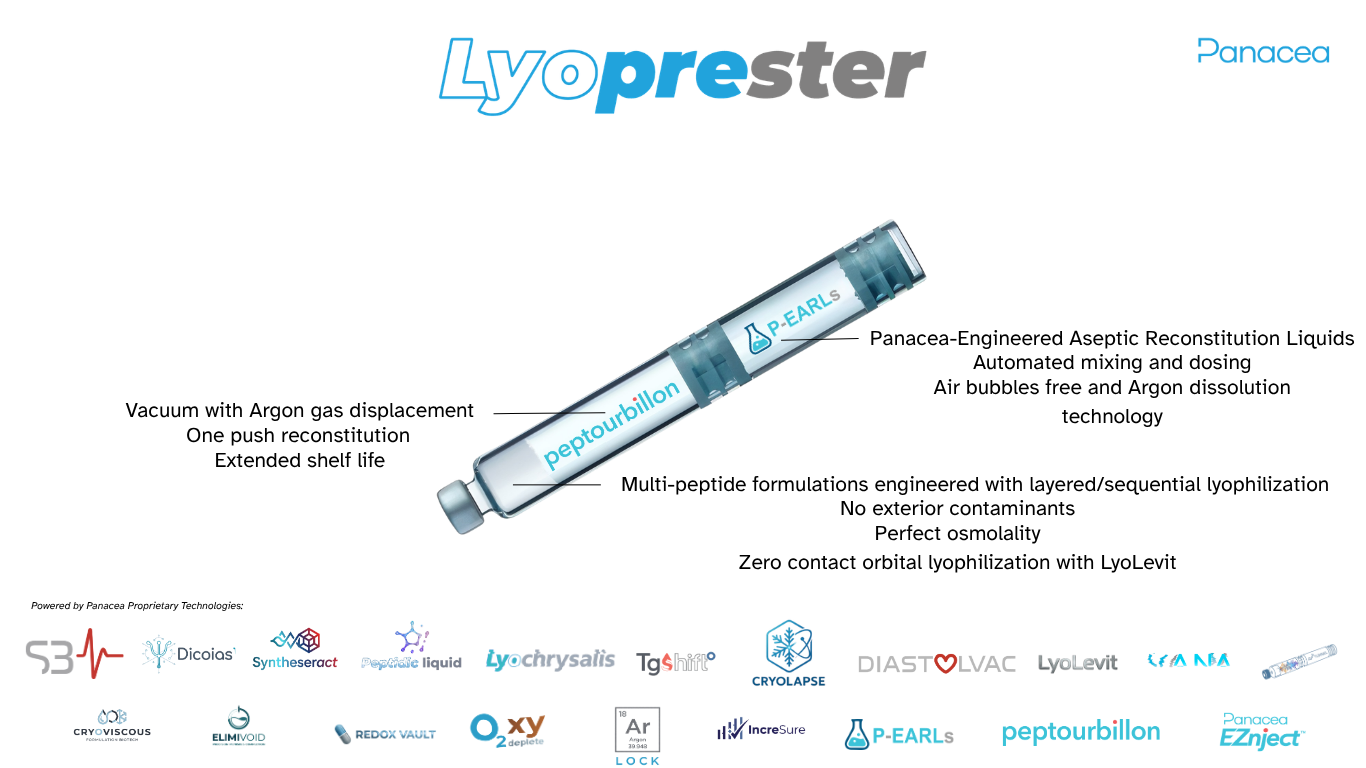
is freeze-dried into the upper chamber of a dual-chamber
Lyoprester® cartridge →,
ready to reconstitute into a fresh solution at the point of use. The companion brief
Bodenkor™ →
follows the same foundation from the basement-membrane side.
Keeping a fragile chain intact — the Panacea stack
A peptide that supports the matrix is a delicate chain, and its value lives in its fold. Panacea's craft is
keeping that fold intact from synthesiser to dose by drying the cake gently rather than harshly. That rests on
TgShift™,
a glass-transition-shifting methodology that raises the temperature at which a drying cake would
otherwise collapse — the benefit Panacea aims for being a longer-lived cake, a cleaner reconstitution and
preserved binding affinity. The whole cycle — temperature, pressure and timing — is watched and logged in real
time by the
S3Pulse™ orchestration engine,
so each cake is dried to the same gentle profile. It is the same discipline Panacea brings to every fragile
chain, here in the service of the body's structural ground.
The specifics behind Panacea's matrix-integrity work are held as a proprietary Panacea Bio Chem programme,
developed by Bogdan Dicoias — an inventor and biochemist who works largely out of view, and whose
peptide and preservation technologies have quietly drawn interest from across the pharmaceutical industry. The
outline of the work is public; the specifics stay behind the door.
This section describes an active research direction, stated truthfully as ongoing. Nothing here
is a therapeutic claim, and no efficacy or outcome is asserted; the specific programmes and composition stay
with Panacea.
6. Where the "foundational core" idea reaches furthest
Because the matrix underlies every tissue, its integrity is a broad, high-leverage theme. Directions where
the body's structural ground is a live area of scientific and everyday interest include:
Skin and connective-tissue resilience. Suppleness, firmness and recoil rest on a well-kept
collagen–elastin scaffold set in healthy ground substance — the most visible everyday window on matrix
integrity.
Tissue engineering and repair. Decellularised matrix and rebuilt basement membranes give a
patient's own cells a template to grow along — a fast-moving frontier of regenerative science.
Joint and cartilage cushioning. Cartilage is almost pure matrix; its shock-absorbing gel of
proteoglycans is a clear case of the ground substance carrying a load.
Barrier and filtration integrity. Basement membranes filter and anchor across kidney, vessel and
skin — where the foundation must stay sound for the structure to work.
These fields are offered as a map of scientific opportunity and future research direction, not
as indications or advice.
Frequently asked
What is the extracellular matrix, in plain terms? The scaffold the body builds outside its
cells — tough collagen and elastin fibres set in a water-rich gel, the ground substance — that gives tissue
its shape and strength and anchors, feeds and signals the cells within it. Bodencore treats it as the body's
foundational structural core.
What is the ground substance? The clear, gel-like part of the matrix between cells and fibres,
made of glycosaminoglycans, proteoglycans and glycoproteins. It holds water, cushions tissue, lets nutrients
and signals diffuse, and helps organise how collagen assembles.
What is the basement membrane? A thin, specialised sheet of matrix beneath every layer of
epithelial and endothelial cells — type IV collagen, laminins, nidogen and perlecan — that anchors cells,
filters, binds growth factors and guides tissue repair. The literature calls it the foundation of epidermal
integrity.
How does Panacea Bio Chem relate to matrix integrity? Panacea Bio Chem researches structural-matrix integrity and matrix-support peptide science as an ongoing direction, described here in beneficial, non-medical terms. The specific programmes are proprietary to Bogdan Dicoias. Nothing here is medical advice.
Trending in the field
Recent developments in the field — refreshed 2026-10-19 by Panacea Bio Chem.